Experience the Ancient, Time Travel in Crete
By Diane York
Published in Times of the Islands Magazine in Jan/Feb 2024
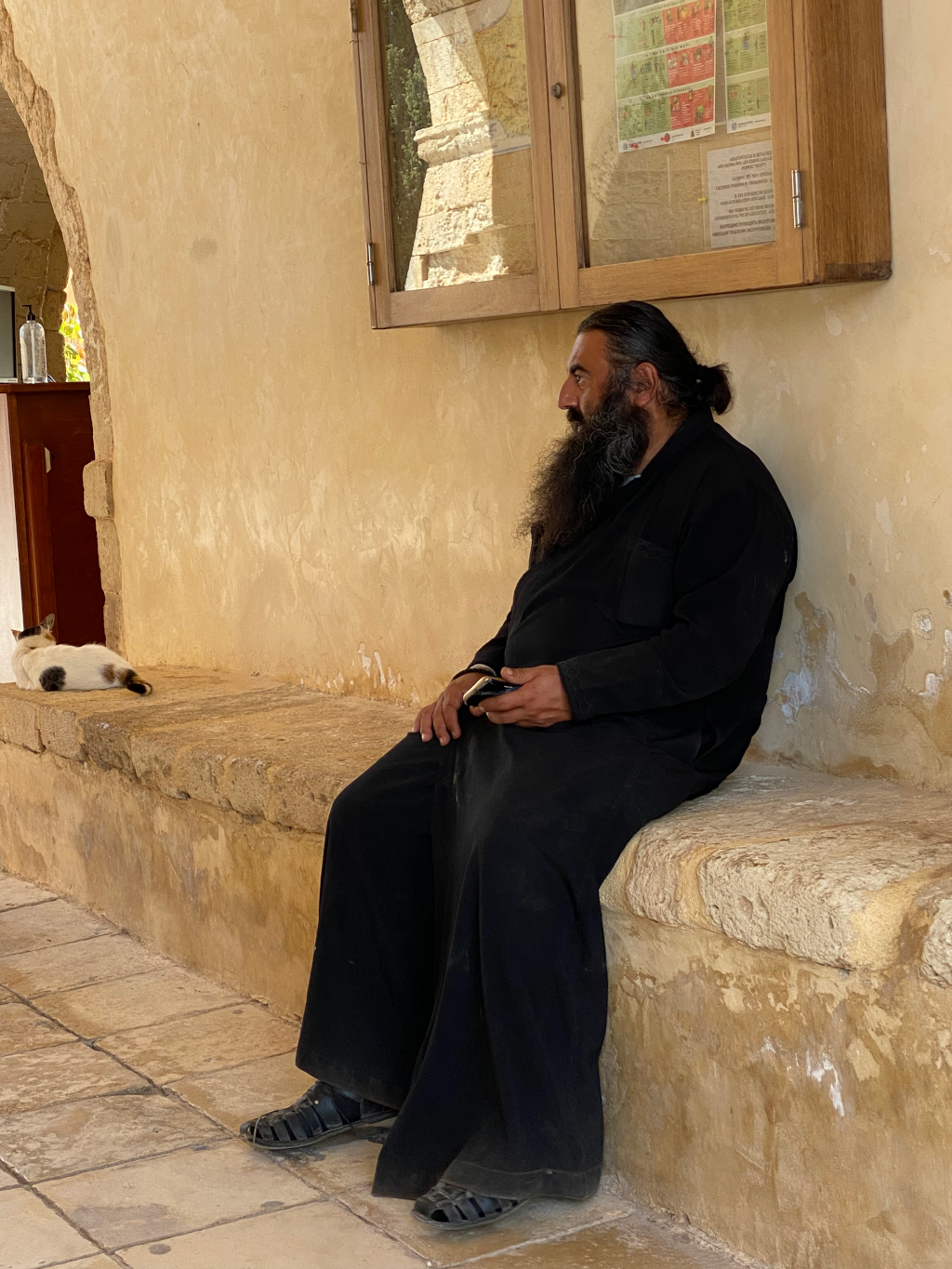
If you have always wanted to try time travel, Crete is a great place to start. There are hidden villages where the customs from the ages are still practiced. You can see magnificent churches and monasteries where black-robed monks chant and pray and “old towns” or Plakas that originated when King Minos ruled. Some of Greece's most classic mythology began here. And beyond all that, beaches with clear water and endless sun. Mountains and gorges for exhilarating driving or climbing adventures.
Two friends and I set out to find the mysteries of Crete. We started at Elounda Bay, a short drive from the Heraklion airport. Cliffside resorts look out over the blue Aegean Sea and you can swim in a pool with a view of the bay to calm your nerves after your flight. We stayed in the Kava Bay resort, with white, rustic apartments. Across the street is a treed, paved path that follows the coastline into town and a small half - moon beach. Walking this path at dusk with the sky turning pink and hazy and the fishing boats coming in for the night, you will meet tourists from Ireland and the UK walking into town for their dinner. “Tis a lovely evening, isn’t it?” from the Irish and “Splendid night, eh?” from the Brits and you begin to fall into the relaxed pace of Crete.
The next day, we drove to the Palace of Knossos, the most important archeological site on Crete. Built around 2000 BC, it’s a very large complex with some areas restored by the archaeologist, Sir Arthur John Evans, who discovered it. In its day, it was the center of Crete, the palace being the most important site on the island and the source of so much Greek mythology. King Minos dwelt in the palace at Knossos.
He had the famous architect Daedalus construct a very large maze beneath the palace to retain his son, the Minotaur., a half-man, half-bull monster who roamed the labyrinth searching for victims. The palace was elegant, with a dancing floor and separate quarters for the king and queen. It was here that Daedalus created wings of feathers and wax. His son, Icarus tried the wings but flew too close to the sun, the wax melted, and Icarus died from the fall. These stories are part of our Western consciousness and have survived as oral tradition for thousands of years. The people are gone, the buildings destroyed, but their stories remain. While some resent the reconstruction and painting of the remaining temples, it gives one a view of how splendid this must have once been. Panels on the walls have murals of bulls, dancers and flowers painted four thousand years ago that are breathtaking. You are walking in the footsteps of great Greek figures like King Minos, Zeus and Europa. You can see some of the exquisite treasures excavated from this site at the Heraklion Archaeological Museum nearby.
The next day we drove to the tiny medieval village of Krista, high in the mountains and next to the gigantic Krista Gorge. The Gorge is a famous spot for ambitious climbers and hikers. Climbing up the mountain in our little four-cylinder Fiat, we found ourselves crossing a bridge over water that had a clearance of no more than six inches on either side of the car. The ascent became almost vertical and the little Fiat couldn’t handle it, sliding backward towards the water. Our fearless driver had to back over the tiny bridge with us, giving him the approximate distance left on either side as we went.
We found a less terrifying route to Krista and explored its winding streets. Small white houses with painted wood trim and doors in blue or pastel colors. Brilliant red and white bougainvillea hangs over the walkways. Wisteria and grape vines wind their way up the sides of buildings. Every house and shop had flowers in pots in front of them. Grandmas (called Ya Yas) dressed in black walked the streets with grandchildren on their way to the market. It’s the custom for widows to wear black for the rest of their lives.
One symbol seen everywhere is the “mati” or “blue eye.” It is a token of blue and white circles (or black and turquoise) that protects against the actual “evil eye,” a malevolent glare that brings bad luck, illness, or misfortune. Worn as jewelry or hung in homes and cars, this amulet reflects the gaze back to the sender, protecting its owner. We found artisan galleries and shops with locally made clothing and jewelry and, of course, bottles of Raki. (Raki is the Cretan version of moonshine.)
In an open-air taverna nestled under a grapevine arbor, we stopped for dinner. Our waiter brought us a fine meal of baked lamb and stuffed tomatoes, and Hora (local wild greens that are actually quite tasty.) We toasted our driver with Raki for his bravery and cool in getting us over the bridge. Our waiter brought us a free dish of watermelon as a dessert. This is a charming custom at many Cretan restaurants.
The drive from Knossos to Kalamaki Beach (South) took us by the Samaria Gorge, an incredible sight, another favorite of hikers and climbers. Crete has mountains too with roads that spiral upward in a dizzying curl. On the way, we saw miles of olive groves, some with fantastically large and twisted trees, The thickest trees are verified at over 2,000 years old and were tended during the time of Christ. It's quite a feeling to walk amidst these groves knowing how many civilizations ate olives from these same trees.
Some of the churches here date to the early Christian era about sixth century AD. You can find candles to be lit for a loved one or if you have a disease, a square tin plate with the hammered image of whatever part of you is ailing to be purchased for an offering and hung as a prayer request for healing.
Our next stay was the Aglaia Hotel in the village of Pitsidia, near Kalamaki (South) beach. The hotel is run by a German hostess, Aglaia who came to Crete on vacation and met and married a Greek man, Yannis. It is in sight of and a short walk to the beach. It is a lovely house with gardens of oleander, yellow hibiscus, blue flax and orange and fig trees laden with fruit.
Aglaia greeted us hot and thirsty travelers with orange juice and figs which grown in her garden. The orange juice here is usually fresh from local groves and is delicious. We found Kalamaki Beach to be a German enclave with many German restaurants and German tourists. We ate at a German restaurant right on the beach, finding schnitzel and braised cabbage in Crete!
Standing on the ocean’s shore the country of Libya is directly South, Athens is directly North, Cyprus is to the East and Sicily and Tunisia are to the West. You are in the center of an ancient sea trade route that brought together multiple cultures of the world and whatever knowledge they had to help build the unique, brilliant center of enlightenment and science that Greece once was.
That night, stray cats decided to line up outside my hotel door and yowl all night. Cats are everywhere in Crete. It seems that restaurant owners tolerate them and tourists feed them. They are in my experience fat, plentiful, and happy. I walked to the beach that night and waded in the Libyan Sea, watching the August Super Blue Moon rise, which was astoundingly large and luminous.
The next day, following the coast, we drove to the small port town of Chora Sfakion is beautiful with stacked, square, white cube shaped buildings stacked against the hillside and overlooking the bay. Piles of hot pink bougainvillea hang over balconies and palm trees are squeezed in between the buildings. Lovely covered market and tavern area on the edge of the water. One of the great perks of Crete is how reasonable guest rooms are. We had balconies with full views of the Aegean Sea for $50 a night. There is a beautiful beach called Vrissi, pebbly with great rock formations and clean, clear ocean water and stone formations that look like they were built by giants. We ate a massive lunch at aptly named Kitchen Dreams. Chicken salad, beet salad, stuffed tomatoes, stuffed peppers and meatballs. Ice cream in every flavor imaginable was available everywhere.
On our way to Rethymno, we found the Arkadi monastery rising like an ancient giant out of the barren landscape and dusty soil.
Arkadi Monastery, founded in the 13th century, is about 20 minutes by car from the town of Rethymno in northern Crete. Its construction is very reminiscent of the Spanish Cathedrals in the New World. Three bells centered in its tower, wait to signal good news or bad to local inhabitants. It is a fascinating place to explore with the church, monastic cells, galleries, and a shop that sells wine, honey, olive oil, as well as exquisite religious art painted on tin, much of which is made on the premises.
There is a tragic story associated with it. In 1866, the Turks stormed the monastery. The occupants, (thought to be 1,000 men, women, and children who had taken refuge there) knew they would be captured by the Turks. Rather than suffer that fate, they gathered in the armory, and the monks detonated a powder keg with one gunshot that exploded and killed all of them. For this reason, the monastery is an important symbol of Crete’s independence.
Further on is the old port city of Rethymno, where you can step back into the 16 th century when the city thrived from Venetian trading. The architecture features wrought iron balconies, long windows, and buildings that once were mosques giving the city its Middle Eastern feel. The old town here is fun to explore. It is centered at the huge Four Martyrs Church surrounded by a maze of short streets and alleyways full of shops that sell handmade silver and gold jewelry, traditional Greek clothing, herbs, spices, local cheese, honey and Mastiha, (a traditional liqueur made from resin from the island of Chios,) They lead down to the waterfront. On the waterfront, huge hangar-shaped buildings were used to build and house the Venetian fleet. There is a naval museum with a full-scale Venetian trading galley.
Here you will find wall-to-wall open-air tavernas with traditional Greek foods and Cretan delicacies such as sea urchins and snails. While I passed on the sea urchins, I did, however, love the kleftiko which was lamb, in the most incredible sauce of mushrooms and melted cheese cooked in a parchment sack.
A short drive from Rethymnon is the high mountain haven of Spilli. At the height of the Venetian era in Crete, Spilli was treasured for its cool, heavily treed, mountain atmosphere. It’s main square features Fontana Dei Lione,” a series of lion head fountains spewing mountain water so clean they say you can drink it without filtration. The town has shaded verandas, taverns with arbors and small stores. In one shop called Delfina, featuring jewelry, fabrics and clothing, I met Janet Jackson, the proprietor. She moved here from Dublin, Ireland, sixteen years ago. She says, “I love the people, the climate, and the simple way of life.”
There was so much more to be seen on this small island with its layers and layers of civilizations- it deserves another visit. But wherever you go in Crete, there is a pervasive sense of the ancient.